
Translational Muscle Pipeline
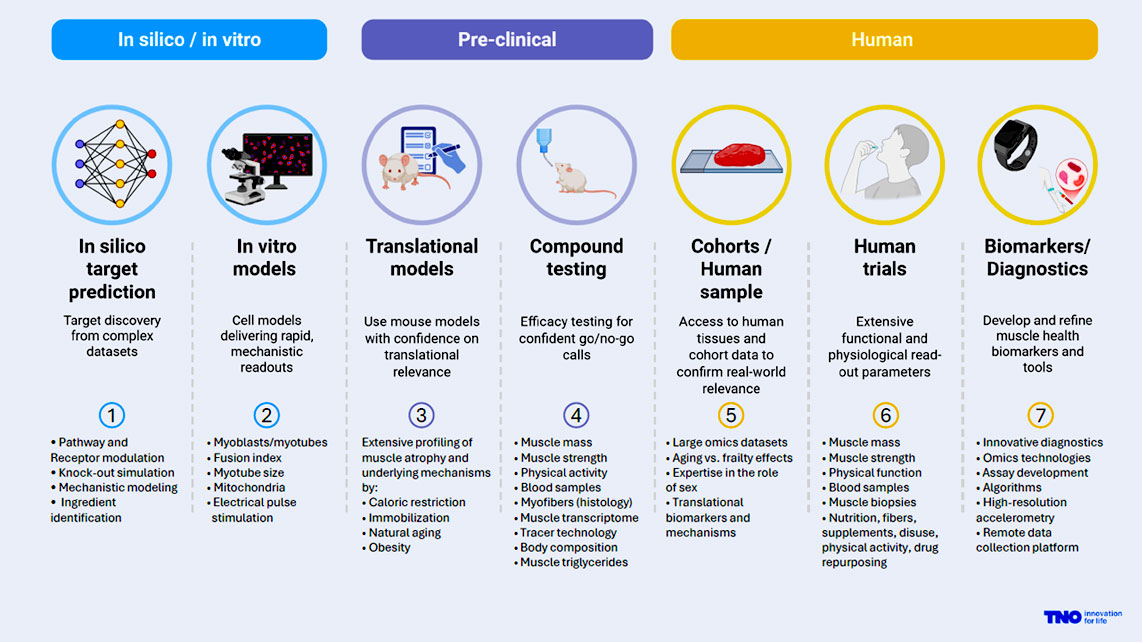
in silico, in vitro, in vivo, Cohorts Human sample. Biomarkers/Diagnostics
The prevalence of sarcopenia is increasing and effective interventions are required to prevent or reverse age-related muscle loss. However, it often is challenging, expensive and time-consuming to develop and test the effectiveness of such interventions and translational animal models that are adequately mimicking the underlying physiological pathways are scarce. Strong predictors for the incidence of sarcopenia include a sedentary life-style and malnutrition.
TNO has therefore recently developed a new and short (2 weeks) mouse model for muscle atrophy that combines caloric restriction with partial immobilization (of one hindleg). This combination model exhibits loss of muscle mass and function. Transcriptome analysis demonstrated that the underlying pathways of this combination model revealed more similarity with the human underlying pathways than aged mice.
In addition to the combination models, we previously demonstrated a beneficial treatment effect in the CR alone model (van den Hoek AM et al., Metabolism 2019).
In addition to the abovementioned models, TNO has several technologies (including AMS; Low dose 14C-alanine incorporation to enable high sensitive detection and tracing of protein turnover in muscle) available for muscle related translational and clinical research. In addition, we perform biomarkers research and can support companies with sensors/eHealth solutions in this therapeutic indication.
 Download more information in pdf
□ TNO's Translational Muscle Pipeline
Collaboration program
In addition, TNO is leader of a research consortium that focuses on a better understanding of sarcopenia, including the underlying mechanism.
An unique human cohort is studied to further validate the translatability of our models and to identify biomarkers.
In addition, male/female differences will be studied.
Future directions
・We are also investigating Muscle Health in relation to cognition.
・Muscle health in relation to menopause.
・Muscle Health in relation to the use of GLP-1 analogues (semaglutide/Ozempic).
Latest News; the paper in Diabetes and Metabolism Journal, July 2026
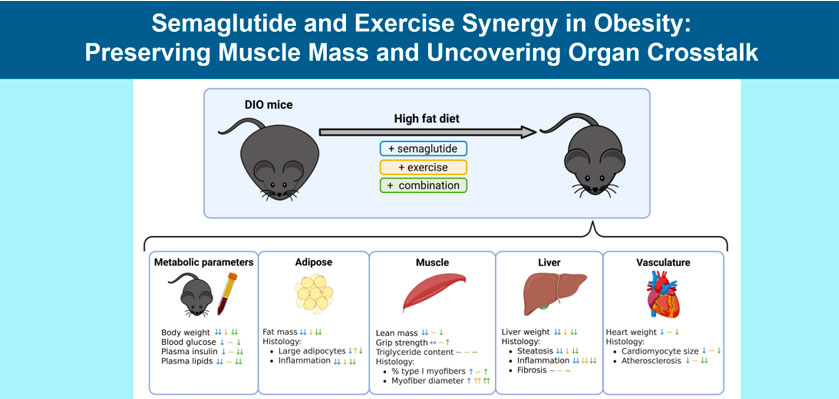 GLP-1 receptor agonists such as semaglutide have transformed obesity treatment by inducing substantial weight loss and improving metabolic health.
However, part of that weight loss comes from lean body mass, raising concerns about long-term muscle health.
In our newly published study, we show that combining semaglutide with exercise not only attenuates lean mass loss and improves muscle function, but also further enhances insulin sensitivity, liver health and cardiovascular outcomes compared with semaglutide alone.
Using the translational Ldlr-/-.Leiden mouse model of obesity, metabolic dysfunction-associated steatohepatitis (MASH) and atherosclerosis, we found that the combination activated distinct molecular pathways across multiple organs that were not engaged by either intervention alone.
Link to the paper
GLP-1 receptor agonists such as semaglutide have transformed obesity treatment by inducing substantial weight loss and improving metabolic health.
However, part of that weight loss comes from lean body mass, raising concerns about long-term muscle health.
In our newly published study, we show that combining semaglutide with exercise not only attenuates lean mass loss and improves muscle function, but also further enhances insulin sensitivity, liver health and cardiovascular outcomes compared with semaglutide alone.
Using the translational Ldlr-/-.Leiden mouse model of obesity, metabolic dysfunction-associated steatohepatitis (MASH) and atherosclerosis, we found that the combination activated distinct molecular pathways across multiple organs that were not engaged by either intervention alone.
Link to the paper
14C-Pulse-Chase Technology: translational and mechanistic evidence for drug efficacy.
Flux Analysis using 14C and AMS; De Novo Lipogenesis, Muscle Protein Turnover, etc
Standard metabolomics tells you what is present. Pulse-chase analysis tells you what is actually happening.
By combining 14C microtracers with Accelerator Mass Spectrometry, we quantify real-time biochemical pathway activity in vivo,
generating the mechanistic proof-of-concept data that plasma biomarkers and static metabolite snapshots cannot deliver.
Why static metabolomics is not enough?
The development of drug candidates targeting biochemical pathways runs into one fundamental problem: the gap between what a biomarker suggests and what the drug actually does in human metabolism.
Plasma values for lipids, glucose or liver show how much is present at a given moment, not how fast metabolic processes are running, which pathways are active, or where an intervention genuinely takes effect.
This distinction is not academic; drug candidates with promising static biomarker profiles regularly fail later because the mechanistic foundation was absent.
At the same time, IND packages are weakened by a lack of data on how a compound behaves in a human-relevant system at the point when course correction is still affordable: before Phase I.
Pulse-chase analysis addresses this directly. Rather than measuring what is present, we quantify the activity of specific pathways in a living system, in real time, by determining the turnover rate of a pathway probe.
What is AMS-based 14C-Pulse-Chase Technology?
Pulse-Chase Technology quantifies the rate at which metabolites flow through enzymatic networks in vivo. Where standard metabolomics provide a static picture, PCT delivers dynamic insight: which pathways are active, at what rate, and how do pharmacological interventions influence those pathways.
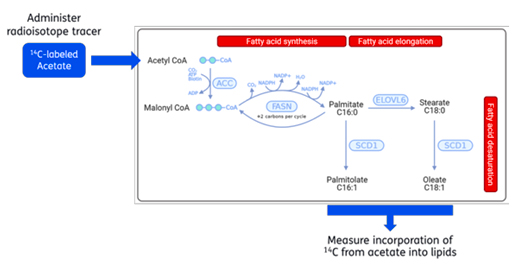
We use specifically 14C-labelled Pulse-Chase Technology (14C-PCT) in combination with Accelerator Mass Spectrometry, a detection technique capable of quantifying 14C-labelled compounds at attomole levels in biological samples. This enables us to administer doses of 14C-labelled probes at non-perturbing levels,
so called microtracer levels, whilst still generating reliable, quantitative data on pathway activity, tissue distribution rate and metabolic processing.
The result is direct, quantitative data on how a drug candidate influences the rate at which the probe is converted through its metabolic pathways in vivo in animal models, in man or for translational read-outs, in both.
 Application
● De Novo Lipogenesis (DNL)
● HDL funcitionality / Reverse Cholesterol Transport
● Muscle Protein Synthesis & Breakdown (combined 14C and D2O analysis)
● Glucose Metabolism (DNL, conversion to fluctose)
Technical info:
●
Flux Analysis using 14C and AMS
Publication
□ Anabolic effects of salbutamol are lost upon immobilization. J Cachexia Sarcopenia Muscle 2025; 16: e70114. doi.org/10.1002/jcsm.70114.
de Jong JCBC, Jameson TSO, Andrews RC, Dunlop MV, Abdelrahman DR, Murton AJ, Caspers MPM, Worms N, van Nieuwkoop A, Keijzer N, Cheng Q, GuigasB, van Duijn E, Vaes WHJ, Nieuwenhuizen AG, Keijer J, Wall BT, Verschuren L, Stephens FB,| van den Hoek AM, Dirks ML.
□ Blood-based biomarkers for early frailty are sex-specific: validation of a combined in silico prediction and data-driven approach. Geroscience 2025; 47:3741-3758. doi: 10.1007/s11357-024-01449-w.
de Jong JCBC, Caspers MPM, Dulos R, Snabel J, van der Hoek MD, van der Leij FR, Kleemann R, Keijer J, Nieuwenhuizen AG, van den Hoek AM, Verschuren L.
van de Meene MRC, van den Hoek AM, Hanemaaijer R, Verschuren L, de Jong JCBC. In vitro muscle contraction: A technical review on electrical pulse stimulation in C2C12 cells. Exp Physiol 2025; 1-16. DOI: 10.1113/EP092677.
□ Translatability of mouse muscle-aging for humans: the role of sex. Geroscience 2024; 46: 3341-3360. doi: 10.1007/s11357-024-01082-7.
de Jong JCBC, Caspers MPM, Worms N, Keijzer N, Kleemann R, Menke AL, Nieuwenhuizen AG, Keijer J, Verschuren L, van den Hoek AM.
□ Caloric restriction combined with immobilization as translational model for sarcopenia expressing key-pathways of human pathology. Aging Dis 2023; 14: 937-957. doi: 10.14336/AD.2022.1201.
de Jong JCBC, Caspers MPM, Keijzer N, Worms N, Attema J, de Ruiter C, Lek S, Nieuwenhuizen AG, Keijer J, Menke AL, Kleemann R, Verschuren L, van den Hoek AM.
□ Diet and exercise reduce pre-existing NASH and fibrosis and have additional beneficial effects on the vasculature, adipose tissue and skeletal muscle via organ-crosstalk. Metabolism 2021;124:154873. doi: 10.1016/j.metabol.2021.154873.
van den Hoek AM, de Jong JCBC, Worms N, van Nieuwkoop A, Voskuilen M, Menke AL, Lek S, Caspers MPM, Verschuren L, Kleemann R.
□ Intramuscular short-chain acylcarnitines in elderly people are decreased in (pre-)frail females, but not in males. FASEB J 2020; 34:11658-11671. Doi: 10.1096/fj.202000493R.
van der Hoek MD, Nieuwenhuizen AG, Kuda O, Bos P, Paluchova V, Verschuren L, van den Hoek AM, Kleemann R, Veeger NJGM, van der Leij FR, Keijer J.
□ A novel nutritional supplement prevents muscle loss and accelerates muscle mass recovery in caloric-restricted mice. Metabolism 2019;97:57-67. doi: 10.1016/j.metabol.2019.05.012.
van den Hoek AM, Zondag GCM, Verschuren L, de Ruiter C, Attema J, de Wit EC, Schwerk AMK, Guigas B, Lek S, Rietman A, Strijker R, Kleemann R.
