
HUMAN MODEL TO STUDY INTESTINAL ABSORPTION AND GUT WALL PROCESS
AVAILABLE AS CONTRACT SERVICE, ALSO FOR PARTNERING
Ex vivo model; InTESTine (the model with Fresh intestinal tissue segments)
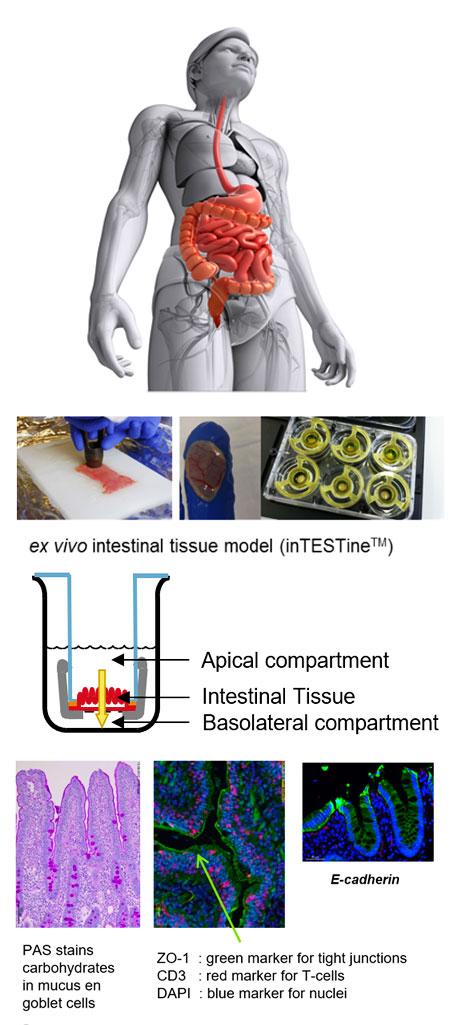
InTESTine is the opportunity to study multiple intestinal segments (duodenum, jejunum, ileum & colon) in parallel, under controlled conditions,
in order to study regional differences in absorption. This is important, as the morphology and function of the intestinal tract changes from duodenum to colon with respect to thickness of the mucus layer, height of the villi, pore size of the tight junctions,
expression levels of transporters, receptors and/or metabolizing enzymes. Additionally, due to the presence of the mucus layer, intestinal processes can be studied following exposure to digested samples, and in the absence, or presence of microbiota.
This clearly demonstrates the additional value of InTESTine compared to monolayer cultures (e.g. Caco-2 cells) in order to study absorption, metabolism and/or food-drug and excipient-drug interactions of orally administered compounds.
Application of fresh intestinal tissue segments.
Intestinal absorption of nutrients and drugs
● Processes that determine intestinal absorption: active transport, metabolism, food -drug effects, excipient -drug effects.
● Intestinal absorption of proteins , (cyclic) peptides and PROTACs.
● Mucus interactions; Adhesion / Secretion.
● Study regional differences in absorption.
● M-cell mediated absorption of lipophilic compounds.
● Intestinal Allergen Transport and Basophil activation.
● Healthy vs diseased populations e.g. IBD, Crone's disease.
Barrier integrity & function
● Paracellular & transcellular transport markers.
● Tight junctions.
● Diarrhea markers.
● Immune response.
● Histology.
Enteroendocrine effects
● Satiety hormones, serotonin, melatonin.
Functionality, Integrity and Viability Markers are used in Every Study
● [3H] -mannitol/atenolol (paracellular transport route).
● [14C] -caffeine /antipyrine (transcellular transport route).
● FD4, MW 4000 (tissue integrity marker).
● Lactate dehydrogenase secretion (viability).
Detection methods
● ELISA, Luminex, Fluorescence, FACS, RNAseq, Radiolabels, RT-PCR, qPCR, HPLC/UPLC, LCMS/MS, AMS
Download:
● InTESTine (Brochure)
Poster from the ISSX 16th European meeting Basel Switzerland 2026
● Prediction of Human Clinical Pharmacokinetics based on Ex Vivo Models of the InTESTine, Liver and Kidney Combined with Physiologically Based Pharmacokinetic Modelling.
Latest news:Unlocking Human Oral Absorption: Advanced Ex Vivo Intestinal Screening model.
Presentation at the 16th European ISSX Meeting, Basel, Switzerland (June 29 - July 2, 2026)
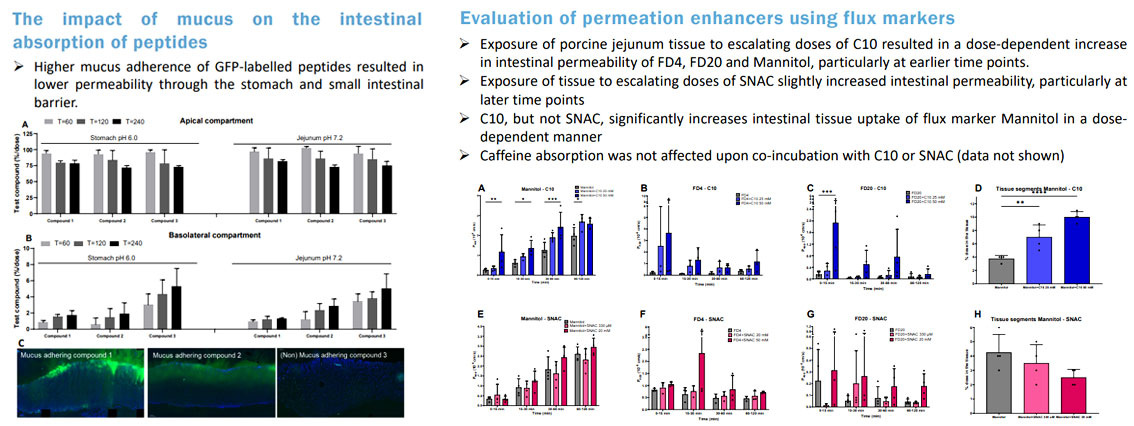 Translating preclinical oral drug absorption to human clinical outcomes remains a major hurdle in drug discovery. TNO’s proprietary InTESTine platform a physiologically relevant ex vivo tissue model utilizing porcine and human intestinal explants bridges the gap between cell line assays and clinical trials, providing predictive, translationally robust ADME data.
Technical Highlights & Platform Capabilities:
● High In Vitro-In Vivo Correlation (IVIVC) for Human Fa Prediction:
Validated with a training panel of 24 small molecules, InTESTine provides precise prediction of human fraction absorbed (Fa)via 4-parameter logistic (4PL) modeling, enabling reliable scaling from Papp to human oral bioavailability.
● Regional Absorption Profiling Across the GI Tract: Accurately map drug absorption dynamics across distinct intestinal regions (duodenum, jejunum, ileum, and colon) in both porcine and human tissues.
● Active Efflux Transporter Functionality: Maintain intact functional expression of key intestinal efflux transporters (e.g., P-gp and BCRP). Validate substrate liability and evaluate transporter inhibitors (such as Quinidine, Elacridar, Ko143, and Pantoprazole) in fresh native tissue.
● Phase I & Phase II Intestinal Metabolic Activity: Demonstrate intact metabolic capability, including CYP2A6-mediated Phase I oxidation (e.g., coumarin hydroxylation) and subsequent UGT/SULT-mediated Phase II conjugation.
● Evaluation of Permeation Enhancers for Peptides & Oral Delivery: Screen and quantify the efficacy of clinical permeation enhancers (such as C10 and SNAC) to boost intestinal permeability for peptides/proteins (e.g., Oxytocin, Insulin) and non-traditional chemical modalities (e.g., bRo5, PROTACs).
Download, Publication:
● Translational and Physiologically Relevent Ex Vivo Intestinal Screening Platform for Predicting the Oral Absorption of Small Molecules and Peptide Formulations.
Gut-on-a-Chip, Host-Microbial Interaction model
We aim to develop a physiological in vitro human intestinal model that can be used to study (drug) absorption and impact of drugs, nutrition and microbial
environment on gut health. The ultimate goal is to develop a population-on-a-chip model to aid in the development of precision medicines by targeting patient
variability using intestinal tissue and microbiota from various individuals reflecting populational variation.
Summary:
● A novel microfluidic platform with an enhanced throughput to be able to study (drug) absorption, and impact of drugs, nutrition and microbial environment on gut health.
● Gut-on-a-Chip can be applied to human intestinal tissue biopsies with remained tissue viability and functionality for 26 hours.
● Induction of metabolizing enzymes can be studied.
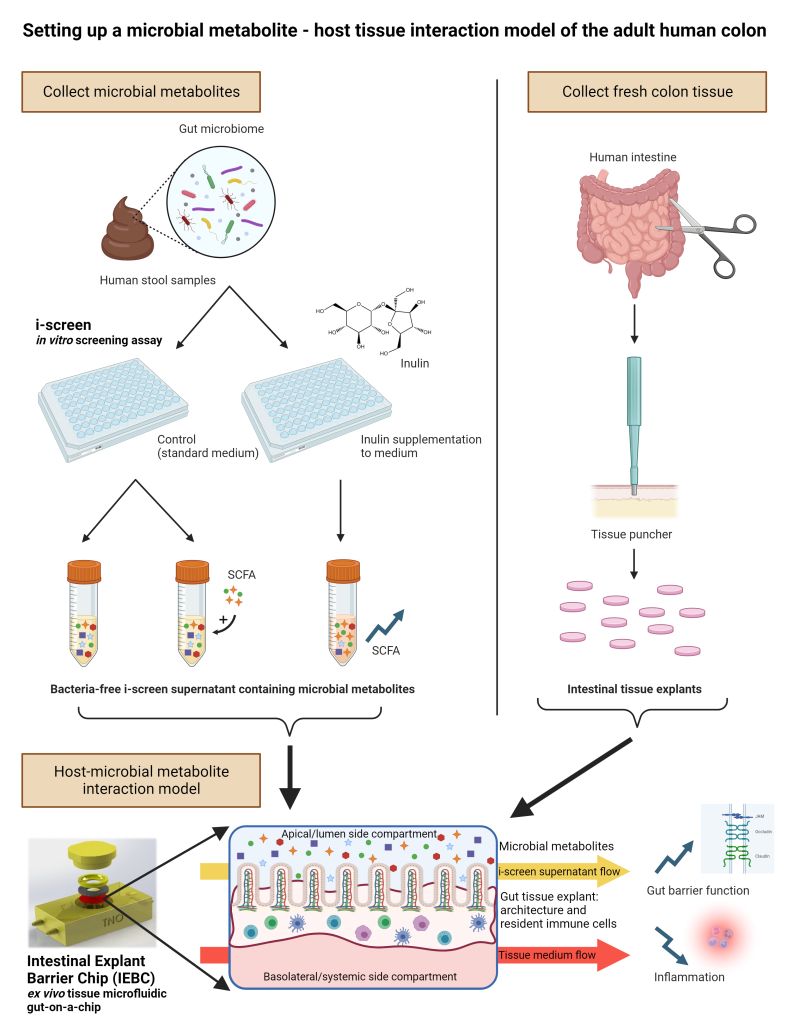
● We are currently using the Gut-on-a-Chip to study in combination with microbial components to study the influence of host-microbe interactions on drug absorption and immune response
Download:
●
Next Level Drug Research in an Ex vivo tissue Gut-on-a-Chip model: Advanced applications of the intestinal explant barrier chip. (Poster at #38JSSX, 2023)
●
A host-microbial metabolite interaction gut-on-a-chip model of the adult human intestine demonstrates beneficial effects upon inulin treatment of gut microbiome (Microbiome Research Report 2024 )
Publication
Microbiome Research Report 2024
A host-microbial metabolite interaction gut-on-a-chip model of the adult human intestine demonstrates beneficial effects upon inulin treatment of gut microbiome
Joanne M. Donkers, Maria Wiese, Tim J. van den Broek, Esmee Wierenga, Valeria Agamennone, Frank Schuren and Evita van de Steeg.
The Royal Society of Chemistry 2021
Intestinal explant barrier chip: long-term intestinal absorption screening in a novel microphysiological system using tissue explants.
Hossein Eslami Amirabadi, Joanne M. Donkers, Esmee Wierenga, Bastiaan Ingenhut,c Lisanne Pieters, Lianne Stevens, Tim Donkers, Joost Westerhout, Rosalinde Masereeuw, Ivana Bobeldijk-Pastorova, Irene Nooijen and Evita van de Steeg
European Journal of Pharmaceutical Sciences 137 (2019) 104989
A higher throughput and physiologically relevant two-compartmental human ex vivo intestinal tissue system for studying gastrointestinal processes
Lianne J. Stevensa, Marola M.H. van Lipziga, Steven L.A. Erpelincka, Apollo Pronkb, Joost van Gorpb, Heleen M. Wortelboera, Evita van de Steeg.
Beneficial Microbes, 2019; 10(3): 225-236
Mechanisms and immunomodulatory properties of pre- and probiotics
V.B.M. Peters, E. van de Steeg, J. van Bilsen and M. Meijerink
Drug Metabolism and Disposition, Apr, 2017
Regional Expression Levels of Drug Transporters and Metabolizing Enzymes along the Pig and Human Intestinal Tract and Comparison with Caco-2 Cells
Stefan F.C. Vaessen, Marola M.H. van Lipzig, Raymond H.H. Pieters, Cyrille A.M. Krul, Heleen M. Wortelboer, and Evita van de Steeg
Journal of Nutritional Biochemistry 32 (2016) 142-150
Nutrient-induced glucagon like peptide-1 release is modulated by serotonin
Dina Ripkena, Nikkie van der Wielena, Heleen M. Wortelboer, Jocelijn Meijerinkc, Renger F. Witkamp, Henk F.J. Hendriks.
European Journal of Pharmaceutical Sciences 63 (2014) 167-177
A new approach to predict human intestinal absorption using porcine intestinal tissue and biorelevant matrices
Joost Westerhout, Evita van de Steeg, Dimitri Grossouw, Evelijn E. Zeijdner, Cyrille A.M. Krul, Miriam Verwei, Heleen M. Wortelboer
